*A one month tourist visa for Cambodia can be obtained on arrival at the international airports in Siem Reap and Phnom Penh for US$20.
Thursday, 18 August 2011
Angkor: The Holy City
*A one month tourist visa for Cambodia can be obtained on arrival at the international airports in Siem Reap and Phnom Penh for US$20.
Monday, 18 July 2011
Tata Madiba...
Tuesday, 12 July 2011
"Circus of the Sun"
These are the words of Guy Laliberte, guide and founder of Cirque du Soleil (which translates to "Circus if the Sun" in English). And it is a goal that was certainly met the night my friends and I watched the show; an astounding production from start to finish, an escape from the real world, a magical experience.
The Cirque du Soleil franchise rose from a troupe of young street performers in Quebec, Canada in 1982. They mixed with the crowd of tourists, artists and collectors in Baie-Saint-Paul, the Mecca for Quebec painters (according to the Varekai Official Programme), walking on stilts and blowing fire. From that moment on, Guy Laliberte, then one of the fire-breathing stilt-walkers, and his contemporaries began the dream of a fantastic journey: to take the Cirque du Soleil troupe around the world.
Since 1985, the troupe began traveling and has performed 28 different themes. Varekai has been seen by over six million people in over 60 cities in over 12 countries since it's debut in 2002. It is a story about destiny and follows the theme of "Wherever the wind carries you, you'll always be home". The 56 performers come from all over the world, from Georgia to Belarus to Italy.
Through some lucky booking, we attained front row seats. Although they were on the side of the stage, we could see almost everything, from every make-up detail and character expression to the scales on a lizard creature's back. Varekai takes place in a deep, dark forest. A firefly flitters about in the sky and a warm wind blows as the sky begins to open. And then you can feel yourself being swept up into another world of music, magic and mischief, only to wake up when the circus tents lights are turned on at the end of the show.
Cirque du Soleil does not use animals in any of their shows, which is entirely refreshing. And the animals are not missed. We could have all watched the show for many more hours. The band must receive special mention for without the wondrous music, the show would have missed the mood and emotion setter. Whether with vocals or only instrumental, the score was hauntingly brilliant.
Dominique Champagne, writer and director of Cirque du Soleil: Varekai, wrote the following in the show's programme, words that have stayed with me since those glorious few hours in May:
"Since these are crazy times and it is our duty not to surrender the world into the hands of fools. May this show be for you as it has been for me, a celebration of the coming together of brothers and sisters and of the joy of challenging limits.
Let yourself be swept away by the courage and beauty of these acrobats, dancers and actors who, every day, wherever the wind may take them, risk their lives trying to attain the sublime, to touch the sky, to defy the law of gravity and to dance in the fires of volcanoes...
So that they can tell the world that something else is possible."
Hope springs eternal, doesn't it just?
Thursday, 2 June 2011
The Hands of Living Mutually
The city of
But

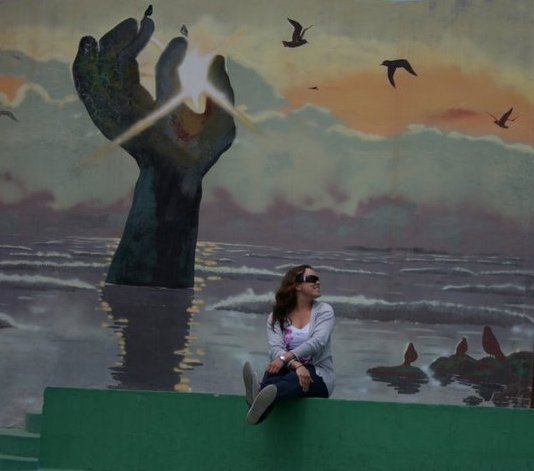
These are two massive bronze and granite sculptures of hands stretching up to the sky. The oddity in the situation is that the one hand (the right hand) stretches up from the water in a small cove. And the second bronze hand (the left and of equal proportion) stretches up from dry land on the Homigot Sunrise Square. The hand in the water is the main attraction, particularly at sunrise, when the sun seems to be rising through the fingers of the hand. As Homigot is on the east coast, the sun rises here first in

Apparently, the hands were constructed in 1999 “to symbolize continuing efforts of all Korean citizens to pursue a better quality of life” (www.frikworld.com). This charming little place is a bit of an absurd tourist magnet. Photographers from all over the country come to take pictures of the sun rising through the fingers of the hand. Some use cellphones, others are professionals. Some will even venture into the water to be closer to the Hand and prove they were really there.
A couple friends and I decided to visit Homigot on a day off. We didn’t make the sunrise, of course. I am not sure what I was expecting but I was a little disappointed by the Hands of Harmony. It is obviously a fantastic artistic concept and quite a sight to behold, this hand stretching up from the ocean. But the Hand was really only a few metres from the shore and it wasn’t nearly as big as I had expected. Beyond the Hand though, stretched the ocean as far as the eye can see. We had a little childish fun scrambling over the rocks and taking silly pictures. The water was also pleasantly warm.

According to the locals and some blogs, New Year's Eve is presumably the best time to visit as there are fireworks and the Homigot National Sunrise Festival runs until

A good one and a half hour bus ride from the Intercity Bus Station or an expensive cab ride away, visiting the Hands of Harmony is a pleasant outing, whether one visits during the day or to watch the sunrise. There is a lighthouse and museum in the vicinity as well as some tourist stores, seafood eateries and several little food and beverage stalls. Don’t buy the roasted chestnuts though, they are expensive and not at all worth it (from experience). A slush puppy is definitely recommendable.
And it is one of the places you just have to see in
Tennis makes memories...
My limited experience of Korean tennis has taken place in the mountains (where I work) and at one tournament in the city. Overall, it has been most surprising, decidedly enjoyable and a little strange, to say the least.
When I arrived at my main school in a little village in the mountains, it was winter and not very pretty. The school is relatively small, with the big field in front and outbuildings at the back, where teachers can stay overnight. The caretaker of the school stays there permanently. There are also the "toilets". What I did notice was a dilapidated old gravel tennis court behind the janitor’s house. I assumed that no one used the court anymore and that it had been left to ruin.
March and most of April passed by in flurry of stress, miscommunication and traveling. I hadn’t thought of tennis at all. After all, I hadn’t really played in
The men obviously assumed I didn’t play tennis, for when I told them I could, they were incredibly excited! I still don’t think they thought I could actually play properly, for when I hit the court one day, all the students were allowed to come and watch me for a few minutes. This never happens in
When we first started to play tennis after lessons, the other teachers were very rusty. But over time and with much practice, everyone has greatly improved. The music teacher has a ‘killer’ volley and smashing skills; the Korean teacher is a master of touch and with practice, has clearly shown he is by far the best player at the school; the vice principal must have been brilliant in his heyday, he still has the forehand to show for it; the math teacher is young and keen to learn, he picked up the backhand slice after only a few attempts. He has a wonderful style.
In the last few weeks, my main co-teacher, who is just starting out, bought a new Babolat racquet. The school bought a box of tennis balls the other day. And the head teacher and sport teacher headed off into the mountains yesterday and came back with a truckload of red clay to add to our “beach court” (as I affectionately name it).
The court is obviously very uneven as we do not have professionals rolling and measuring for us. In some places, the balls bounce and in others, they do not. If it rains, the ground is saturated and actually dangerous to play on. We do, anyway. As I said, the net is about 10 inches too high and there are no proper fences so the balls get lost on a regular basis. But as the vice principal says: “Same conditions for all!” And so we get on with it.
At the end of April, my school entered six of us into the
I was one of three women present and the only foreigner. This created much fuss and it also meant that there were many people watching our court. My mother and a few others will know that I am not very good under pressure and even worse when there are people watching. I managed to keep my cool though and I played a good game. We may have even won our second match if we had played the usual ‘best of three sets’ format.
Korean tennis etiquette is truly something to behold and is probably my favourite part of tennis in this country. When both couples are ready to commence the match, all four players walk to the net and bow and shake hands as a sign of respect for each other. On completing the set, all four players walk to the net and bow and shake hands once more.
There is no such thing as the spinning of the racquet (rough or smooth, up or down, W or M, p or d). One person from each couple with do “rock, paper, scissors” to determine the winner. The winner can then choose to serve of receive. Whichever side you warmed/knocked up on, that is the side you remain on. Before serving the first ball of every game, the server will greet the receiver when he serves to them: “Annyeong-haseyo!” (Good day!/ Hello!) I suppose this is similar to what I would say at home: “Enjoy the match!”
The scoring is my favourite. In tennis scoring, we use “fifteen, thirty, forty, deuce, advantage”. If we are to shorten the score when playing social, we use the abbreviations “five-thirty”, “thirty-forts”, “your ad” etc. Here in
Thank goodness I can play tennis. It has saved my soul here in the mountains. Sometimes, I’ll only play once a week (as most of my lessons are in the late afternoon right before we go home) or sometimes, I shan’t play at all. But sport, like music, is common ground. It is a form of communication all by itself. I always say it and I shall say it again; without sport (and in particular, the game of tennis), I would have far less wonderful memories and far less friends…
Friday, 29 April 2011
Gyeongju - the "Museum without Walls"
On this particular Sunday, I was not in the best condition health-wise and I did not get to Gyeongju early enough in the morning. But I saw as much as possible in the time I was there, guided by some friends who live in the area. It was a delightful, cultural day in the sun...
Gyeongju was the capital of the Silla Kingdom, the longest surviving kingdom in the country, for nearly a thousand years (BC 57-935) and has a vast amount of historical and cultural heritage. UNESCO has designated Gyeongju as a World Heritage site (http://english.visitkorea.or.kr/). After visiting this fascinating place, this is hardly surprising and one can see why it is one of South Korea's biggest tourist attractions, even a millenium after the demise of the Silla dynasty.
According to the Korea's official tourism site, Gyeongju is the nation's most popular fieldtrip destination. (In fact, one of my schools' fieldtrip is to Gyeongju next week.) Ponds, tombs, mountains, temples, grottos, observatories and museums abound in this amazing place. It is also home to many of the greatest Buddhist treasures in Korea.
Cheonmachong Tomb (Tumuli Park) is home to ancient tombs of kings and noblemen of the Silla Dynasty. There are 23 tombs in total, the most famous being Cheonmachong and Hwangnamdaechong. Inside the tombs, relics can be seen from a time long past; remains, crowns and other gold accessories.
Gyeongju also boasts Cheomseongdae, the oldest existing atronomical observatory in Asia (http://english.visitkorea.or.kr/). According to the visitkorea site, it was originally designed to look to the stars as a means to forecast the weather. As one of Korea's national treasures, it is quite an impressive site up close.
What Gyeongju is most famous for amongst us foreigners, is the cherry blossoms in springtime. There is a definite window period to see the blossoms, however, as they last in Gyeonju for only two weeks. My trip to Gyeongju was at the end of the two weeks. Sadly, there was only one tree still cherry-blossoming in Tumuli Park. We certainly made the most of it by taking hundreds of pictures. The cherry blossoms at this time of year are absolutely beautiful.
So are the flowers in springtime, something Gyeongju certainly does not lack.Thursday, 28 April 2011
The madness continues - April 15 to 17...

Once you realise that time flies in South Korea, you also come to realise that a year is not that long, actually, and that if you don't hurry up, you won't see everything you want to see before you leave the country. On the weekends, there is no time to rest or catch up with your writing and no time to stay at home and recover from a heavy week. There is exploration to be done and fun to be had and thus, the madness continues weekly; it's a cycle of non-stop movement, travel and happy exhaustion...
On April 15th, I planned to go and visit a friend, Bells, in Gyeongsan, about an hour and half by bus from Pohang city. From Heung-hae to Pohang, it is at least a 45 minute bus. So, all in all, the trip takes a good two hours. We had arranged to meet for supper and have an early night. Well, as Murphy is my dearest friend, my co-teachers decided to leave school an hour late. For most, this would be a minor setback in the evening's plans. For me, it was a giant hurdle, for I work in the mountains. This means:
- the carpool must drive back to Heung-hae (45 to 50 minutes depending on traffic),
- I must walk to my apartment from the drop-off location (approximately 15 minutes),
- I must collect and pack my belongings (10 minutes),
- I must walk to the bus stop (which I just passed on the way home) and wait for a bus to arrive (anywhere between 10 and 30 minutes),
- I must catch the bus to Heung-hae (45 minutes),
- I must buy a ticket for Gyeongsan and wait for the next bus to leave (average time for waiting + trip = 2 hours).
Therefore, total time travelling = minimum 4 hours = mission.
If I had got the right bus, I would have been there for supper at 20:30ish. Alas, I only got the 20:20 bus and only arrived in Gyeongsan at a mild 21:40. It ended up being quite a late supper, to say the least. Bells and I headed to the student area called Yeungnam, where the University is situated. Our "quiet supper" started very well; we went to a little bar/restaurant and ordered rice and pork and a pitcher of beer. As we were thinking of leaving, we started a conversation with a couple of young students to our left. They offered us a shot of a drink called Chong-ha, which is similar to Japanese saki (wine). Bells looked at me from across the table and said: "You know that if you accept that drink, we will never leave this place." And I said: "Oh no, rubbish. It's just one little drink." Well, the night did not end. We made friends with everyone in the establishment, I spoke every Korean word I have learnt since my February arrival. Our last stop was at a noraebang - a karaoke/singing room - with some of our new-found friends. It was a fantastic Korean experience, truly fantastic!
Saturday was difficult, to say the least. But we managed to wake rather early and head to Daegu. Gyeongsan is a relatively small place in Korean terms but it is also a semi-suburb of Daegu, a very large and happening city. Daegu is all lights and shopping, restaurants and tall buildings. I managed to purchase a desperately-needed sports cap and a handbag and we caught a bit of an outside concert for charity. The highlight was the finding of a little second-hand shop on the way to the subway. It was a lovely day, indeed.
In the late afternoon on Saturday, Bells and I took the bus to Pohang. It was the perfect time of day for a scenic trip through the rural areas; the light was soft and made the mountains and farming fields look movie-worthy. We listened to depressing love-loss, heart-break music and enjoyed the break in the madness.
After one hell of a good party, we woke up on Sunday for our trip to Gyeonju. Gyeonju is 30 to 40 minutes by bus from Pohang. This little place is full of absolute wonder. It isn't called the 'Outside Museum' for nothing. We had a glorious day, despite the aching headaches, in the sun and in the tombs and under the cherry blossoms and amongst the Spring flowers. A truly cultural experience for once...